Requests that work
The same request can produce a generic poster or one that works. The difference is five ingredients and a couple more minutes.
Updated: November 2026
The MuesliEco poster
‘Make me a poster to promote my organic muesli.’ That was all I asked the AI the first time. The posters are in Spanish, as in the talk.
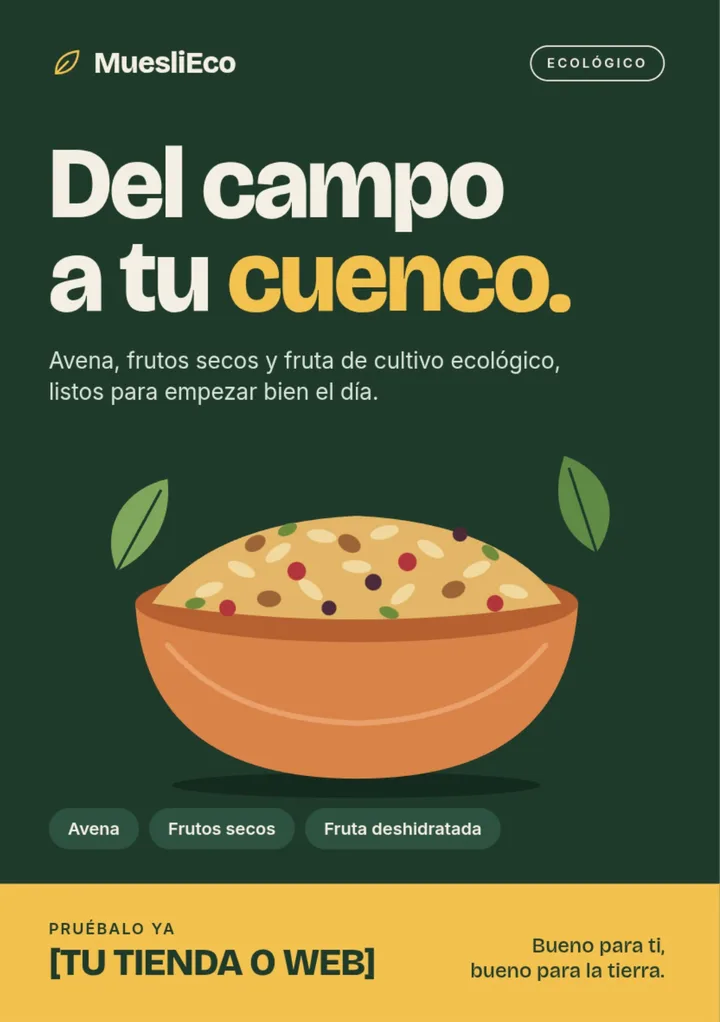
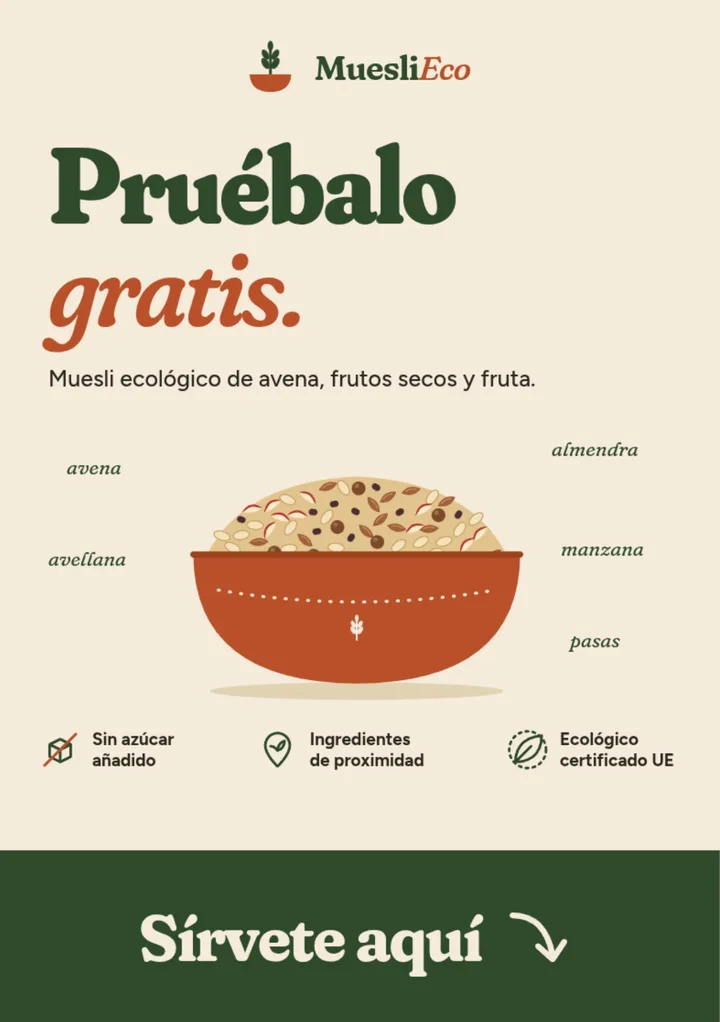
Context. I’m MuesliEco, I sell organic muesli and I’m going to promote it at BioCultura.
Goal. Make me a poster for the dispenser.
Questions. Before you start, ask me for any information you need. Don’t assume anything.
Rules. Nothing generic. Easy to read, not cluttered.
Check. Look at it as a family standing in front of the dispenser would, say what wouldn’t convince you and improve it.
The good poster also used Claude’s brandkit skill, which gives it a consistent brand, colours and typography without describing them. If your tool doesn’t have it, add your colour palette, fonts and logo to the request, or ask it to question you about your visual identity before designing.
The five ingredients
- Context
- Who you are and what it’s for. If it’s in your business context, you don’t need to repeat it.
- Goal
- Exactly what you want: format, length and where it will be used.
- Let it ask you
- Before it starts, so it doesn’t assume. It’s the most forgotten ingredient and the one that changes the result most.
- Rules
- What it mustn’t do: nothing generic, no made-up facts, nothing off your tone.
- How to check itself
- Have it review the work the way your customer would before handing it over.
Context: I’m [who you are] and this is for [what and who it’s for].
Goal: [exactly what you want, with format and length].
Questions: Before you start, ask me any questions you need. Don’t assume anything.
Rules: [what it mustn’t do: nothing generic, don’t make up facts, tone…].
Check: When you have it, read it as [your typical customer], tell me what wouldn’t convince them and improve it.
Prompts ready to copy
Change whatever is in square brackets. The ones for email, Drive, calendar and shop are in the connectors guide.
I’m attaching [number] delivery notes as PDFs. Put them into a table with these columns: supplier, date, delivery note number, product, quantity, unit, unit price and line total.
Rules:
- Copy the data exactly as it appears. Don’t calculate or fill in anything that isn’t in the document.
- If a value is unreadable or missing, leave the cell empty and write ‘CHECK’ in a notes column.
- At the end, tell me how many lines you took from each delivery note so I can check.
Check the table against the originals before using it. In Claude, the Excel skill gives it back to you as a spreadsheet straight away.
Here are [number] customer reviews. Group them by topic and tell me the 3 most repeated complaints.
For each complaint: how many reviews mention it, two verbatim example quotes and one concrete idea to fix it.
Don’t make up reviews or figures: if something isn’t clear, tell me.
Remove customers’ names first: how to anonymise.
I’m attaching the rules for [name of the grant]. Summarise them on one page for a business like mine: [sector, number of employees, region].
- Eligibility requirements.
- Deadlines, with exact dates.
- Documents to submit.
- How much you can get and which costs it covers.
For each point, give the page and section of the rules it comes from. If the rules don’t say, write ‘Not stated’. At the end, tell me whether my business seems to meet the requirements and what I would need to confirm.
Check the dates and amounts in the rules before submitting anything.
Before you answer, ask me the questions you need to do this well, one at a time. Don’t start until I say ‘go ahead’.
Read this text as if you were [typical customer: e.g. a parent who buys organic at a health food shop and reads every label]. Tell me honestly what you wouldn’t understand, what you wouldn’t believe and what would stop you buying. Then suggest an improved version without making up any facts.

[paste the text here]
Let’s rehearse a negotiation. You’re [the packaging supplier] and you don’t want to lower the price because [realistic reason]. I’m [your role] and I want [goal]. Raise realistic objections, one at a time, and don’t give in easily. When I say ‘stop’, tell me what I did well, which arguments I was missing and which sentence weakened my position.
For each fact or claim in your answer, give me the source with its link and copy the exact sentence from the document that says it. If you don’t have a source, say so clearly instead of guessing.
Then open the links: AI points you to the facts; you check they exist.
Talk resources
- Business context templateWho you are, what you sell and how you talk, in one document to paste into the AI. With a filled-in example.
- Skills worth installingThe ones Claude already has and the public ones that are genuinely worth it, with how to install them.
- Connectors guideWhich connectors each tool offers, what to ask them and how to switch them on without handing over more keys than needed.
- Privacy checklistTurn off training, check your shared links and work with customer data safely.
- Greenwashing: phrases to avoidPhrases to avoid, what to say instead and what the law says. Printable.
- AI use policyOne page so your team knows what they can and can’t do with AI.
- SourcesEvery figure from the talk with its link, in slide order.
Still have questions?
Tell me about your case by email or WhatsApp. If I can help, we’ll go through it on a call; if I can’t, I’ll tell you.